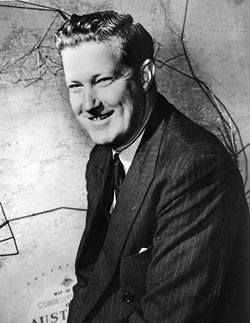
The legendary Don Anderson was born at Waikerie, South Australia in on
1 March 1917. From
Adelaide High School, he went to Adelaide Teachers College and by 1939
was a school teacher in South Australia's Riverland district and on the
Yorke Peninsula. He also tried his hand at journalism, supplementing his
income as a country correspondent for local and Adelaide newspapers.
By the end of 1940 he had joined the RAAF, training as a pilot. He initially served with the 22nd Troop Carrier Squadron, United States Army Air Force, in New Guinea as a transport pilot on troop carrying and supply-dropping missions in early 1942 as the Japanese were pressing down the Kokoda Trail. He later went to the USA as a test and acceptance pilot with USAAF Ferry Command. Don Anderson was Mentioned in Despatches for his war service.

Demobilised in 1946 with 3,000 hours flying in his logbook, Don Anderson returned to Australia and his first post-war job was as an Examiner of Airmen with the Department of Civil Aviation.
With DCA Don Anderson developed staff and operational procedures, and had much to do with recruiting 200 former wartime airmen into Air Traffic Control. In 1948 he was appointed Superintendent of Air Traffic Control and played a major role in the expansion and development of Australia's Air Traffic Control system to meet the new demands of the rapidly growing civil aviation industry.
A member of the Australian delegation to ICAO in Montreal, his organising abilities and knowledge of Air Traffic Control led to him being appointed, in 1948, as Chairman of the Third Session of the Rules of the Air and Air Traffic Control Division, which defined the principles upon which world standards for Air Traffic Control were determined. The symbol of this achievement was Annex 11 of the Chicago Convention on Civil Aviation.
Following visits to the United States, Canada, Britain and several continental countries, his recommendations resulted in the adoption of the Flight Progress Board, and the first ILS Localiser at Essendon Airport.
He was known at the time as "the father of Australian ATC".
In 1952 Don Anderson was appointed Assistant Director-General (Personnel and Establishments), at the age of 35, and the following year was made Secretary-General of the South Pacific meeting of ICAO in Melbourne.
On 1 January 1956, Don Anderson was appointed Director-General of Civil Aviation. He was widely recognised as one of the world's foremost negotiators of international air transport agreements. During his term as Director-General, he led many Australian delegations both in Australia and overseas to negotiate international traffic rights for Qantas, the Australian flag carrier.
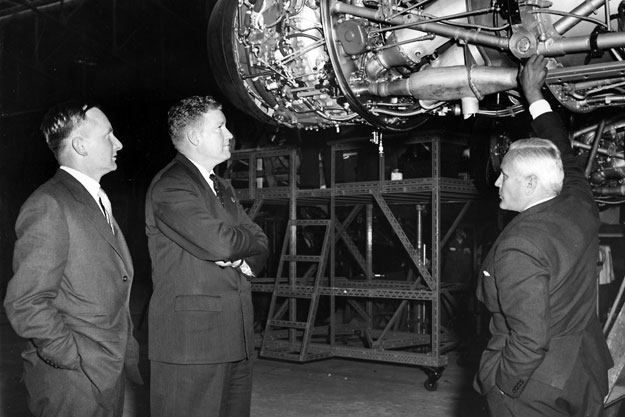
Above: Jim Schofield, Civil Aviation Liaison Officer with the Australian High Commission in London, and Don Anderson are shown over a Vickers Viscount under construction by Henry Sharpe of Vickers during June 1956.
Don Anderson was awarded the CBE in 1959, and created a Knight Bachelor
in June 1967. In
1957 he was awarded the Oswald Watt Memorial Medal for "the most
valuable contribution to aviation by an Australian" in that year.
Outside aviation, Don Anderson's main interest was cricket. He was a former opening batsman with the Melbourne district team Essendon, and in the 1948-49 season topped the club's batting averages.
Sir Donald Anderson ceased duty as Director-General of Civil Aviation on 30 September 1973, and commenced as Chairman of Qantas on 1 October 1973.
He died on 1 December 1975, aged 58.

(Photos: CAHS collection)
Back to the main Departmental People index