Air
Traffic Services Surveillance Systems,
Including An Explanation of Primary
and Secondary Radar
by
Phil Vabre
Introduction
This article describes the various Air Traffic Services surveillance systems in use in Australia, some of their technical features and how they have evolved.
The Arrival of ATC Radar
At the conclusion of the Second World War the rapid wartime development of radar had obvious application in Air Traffic Control as a means of providing continuous surveillance of the traffic disposition, independently of aircraft position reports made by radio. This increased precision would also permit a reduction in the existing procedural separation standards. This in turn promised considerable increases in the efficiency of the airways system.
The first ATC radars used in Australia were wartime air defence units which were used experimentally. These radars were of the type that later became known as 'Primary' radars. That is, they worked on the well-known 'Battle of Britain' principle in which the radar transmitter sends out a pulse of radio energy, of which a very small proportion is reflected from the surface or structure of the target aircraft back to the radar receiver.
The azimuth orientation of the radar antenna provides the bearing of the aircraft from the ground station, and the time taken for the pulse to reach the target and return provides a measure of the distance of the target from the ground station. The bearing and distance of the target can then be converted into a ground position for display to the Air Traffic Controller. Target elevation (altitude) is not normally measured by ATC primary radars.
The advantage of Primary Surveillance Radar (PSR) is that it operates totally independently of the target aircraft - that is, no action from the aircraft is required for it to provide a radar return.
The disadvantages of PSR are that, firstly, enormous amounts of power must be radiated to ensure returns from the target. This is especially true if long range is desired. Secondly, because of the small amount of energy returned at the receiver, returns may be easily disrupted due to such factors as changes of target attitude or signal attenuation due to heavy rain. This may cause the displayed target to 'fade'. Thirdly, correlation of a particular radar return with a particular aircraft requires an identification process. When PSR was the only type of radar available, this was typically achieved by the Controller instructing an aircraft to turn and observing same on their display, or by correlating a DME distance report by the aircraft with the position of a particular return along a known track.
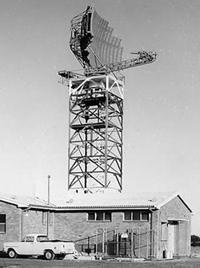
Following a series of trials during the 1950s (see here for the Type 276 radar), the first proper ATC radars were installed at Sydney/Mascot and Melbourne/Essendon in the Control Towers. These were Cossor units with a range of 40NM and the display had to be viewed in a darkened 'cubby house'. The Essendon unit can be seen here.
The value of radar in ATC having been demonstrated, in 1960 DCA ordered its first 'standard' air traffic control radar equipment from French company CSF (later Thomson-CSF). These were primary-only radars with a range, initially, of 120NM (later 160NM). Radar data was displayed to controllers on the 'Bright Display' system which could be viewed in a dimly lit environment. These radars were replaced commencing in the early 1990s under the Radar Sensor Procurement Programme (RASPP) by lower-powered primary units with a range of 70NM.
Secondary Radar
The disadvantages of PSR outlined above led to the employment of another aspect of wartime radar development. This was the Identification Friend or Foe (IFF) system, which had been developed as a means of positively identifying friendly aircraft from enemy. The system which became known in civil use as Secondary Surveillance Radar (SSR), or in the USA as the Air Traffic Control Radar Beacon System, relies on a piece of equipment aboard the aircraft known as a 'transponder'.
The transponder is a radio receiver and transmitter operating on the radar frequency. The target aircraft's transponder responds to interrogation by the ground station by transmitting a coded reply signal. The great advantages of SSR are three: firstly, because the reply signal is transmitted from the aircraft it is much stronger when received at the ground station, thus giving the possibility of much greater range and reducing the problems of signal attenuation; similarly, the transmitting power required of the ground station for a given range is much reduced, thus providing considerable economy; and thirdly, because the signals in each direction are electronically coded the possibility is offered to transmit additional information between the two stations.
The disadvantage of SSR is that it requires a target aircraft to carry an operating transponder. Thus SSR is a 'dependant' surveillance system. For this reason, PSR will operate in conjunction with SSR in certain areas for the foreseeable future so that 'non-cooperating' targets, such as some light aircraft, can be detected.
SSR has several modes of operation, the basic civil mode being Mode A. In this mode the aircraft's transponder provides positive aircraft identification by transmitting a four-digit code to the ground station. The code system is octal; that is, each of the code digits may be any of the numbers 0-7. There are thus 4096 possible four-digit codes (e.g. 3472).
Another principal SSR mode currently used in Australia is Mode C. In this mode the aircraft's altitude, derived from on-board instruments, is transmitted to the ground station in addition to the identity. The use of Mode C was introduced in Australia in the late 1980s with the acquisition of ground systems, such as ATCARDS, capable of processing the information.
A further mode, Mode S (or 'Mode Select'), is also used. Aircraft equipped with transponders supporting this mode are assigned a permanent identification which can be selectively addressed by the ground radar. This reduces problems of garbling between SSR returns from aircraft in close proximity. Mode S also offers a wider range of data to be transmitted, including potentially an uplink of data from the ground station to the aircraft although this capability is presently not used in Australia.
Additional SSR Modes are used by military aircraft.
Incidentally, the phraseologies associated with the use of SSR link back to the early days of IFF when the equipment was code-named 'Parrot'. Thus an instruction to turn off the IFF eqiupment was to "strangle your parrot" and, conversely, to transmit the identification signal was to "squawk" - a phrase still in use today.
SSR Code Groups
SSR codes fall into two groups; discrete and non-discrete. These groupings are a function of the ground radar/flight data processing system rather than the SSR system itself.
A non-discrete code is any code ending in '00' (e.g. 2000). Non-discrete codes may be used ('squawked') by more than one aircraft at a time and some non-discrete codes are allocated as general codes to certain classes of operation. For example, the standard SSR code for VFR aircraft in Australia is 1200 (formerly 2000). Some non-discrete codes are also allocated for emergency use; for example, 7700 denotes 'Mayday' and 7600 'Radio Failure'.
A discrete code, in contrast, is one which may only be assigned to a single aircraft at a time (codes may be re-used when no longer required by the original user). Any code not ending in '00' is considered non-discrete. As an aside, modern flight data processing systems may actually allow the simultaneous use of the same discrete code in certain circumstances.
In Australia for many years all high-capacity Regular Public Transport aircraft were allocated a 'skin' code. This was a discrete code allocated to the individual aircraft hull. The aircraft's transponder therefore never needed to be changed while the aircraft was operating in Australian airspace. This simple system was too difficult for the new TAAATS equipment, so it was discontinued from 1998.
Automatic Dependant Surveillance
The arrival of satellite technology in the late 1980s brought with it the possibility of another type of ATC surveillance equipment, principally for use in areas where radar coverage does not or cannot exist. Originally known by the acronym FANS (Future Air Navigation System), this has matured into the system known as Automatic Dependant Surveillance (ADS). It is Automatic because it requires no pilot or controller input to function (other than turning the equipment on and logging in to the system), and Dependant because it requires operating airborne equipment (like SSR).
The ADS system is basically a datalink system that transmits data from the aircraft's on-board navigation systems about its position, altitude and intentions (projected flight path) to the ground system. In that sense, it can be thought of as an analogue to SSR. Although it was the availablility of satellite technology that gave the genesis to ADS, the system can also use VHF or even HF links to ground stations.
The original ADS system is now known as ADS-C, or ADS-Contract, because reports from the aircraft are generated in accordance with a 'contract' set up with the ground system. For example, the ground system may demand reports when the aircraft reaches top of climb, at position reporting points or other navigational waypoints, or at specified time intervals. These reports basically replace verbal reports from the pilot and facilitate the application of procedural separation.
There is also a further application of the ADS idea, known as ADS-Broadcast (ADS-B). In this system the aircraft has a special transponder that 'squitters', or broadcasts, similar information to that described above, but at a much higher rate of twice per second. This information can be received either by a ground station, for Air Traffic Services use, or by another aircraft. This leads to the possibility of so-called Cockpit Display of Traffic Information (CDTI).
ADS-B commenced trials in Australia in 2003 using the Mode-S Extended Squitter (1090 ES) system, operating in the radar band at 1090 MHz. In December 2009 a network of 28 out of a planned 43 ground stations was commissioned by Airservices Australia, providing continuous high-level coverage (above about FL300 or 30,000 ft) across the Australian continent. Substantial lower-level coverage is also available. Air Traffic Controllers can use ADS-B data for separation in a similar way to radar data.
Multi-Lateration
One final surveillance system used in Australia is multi-lateration. This relies on a number of relatively simple ground stations triangulating on the signals from an ordinary aircraft Mode A/C (or Mode S, or ADS-B) transponder. This system has the advantages of very much simpler, and thus cheaper, ground installation than conventional SSR whilst not requiring expensive, new aircraft equipment as does ADS-B. From an ATC point of view, multi-lateration data is treated the same as if it came from a conventional radar.
In Australia, a Wide Area Multi-lateration (WAM) system became operational in June 2010, using a network of 14 widely-dispersed ground stations to provide coverage in Tasmania. This is one of the largest geographical deployments of WAM in the world to date. As of 2010, a multi-lateration system is also being installed at Sydney/Kingsford Smith Airport with the intention of replacing the existing conventional radar Precision Runway Monitor for the close-spaced parallel ILS approaches.
Back to the main Air Traffic Services index
If
this page appears without menu bars at top and left, click
here.