The
Coming of Aeradio
by
Roger Meyer
The archive
of the Civil Aviation Historical Society contains the ‘Ivan Hodder Collection’
of photographs, documents, tape recordings and memoirs which reveal much about
the coming of civil aviation radio communications to the remote northern parts
of Australia before, during and after World War II. The following article is extracted
from his journals in which he describes a resourceful, hard but rewarding working
life.
Ivan Hodder (1899-1993) was a radio enthusiast by nature, having learned morse code as a sixteen year-old, and went on to join the RAAF Wireless Reserve in 1929. His spare time was spent in building and experimenting with radio transmitters which, he later discovered, was in contravention of military intelligence regulations.
Prior to 1936 there was no wireless organisation available to civil aviation, as no suitable airborne equipment was available. However this situation was now changing and the Director of Signals at RAAF Headquarters, Squadron Leader C.S. Wiggins, was seconded to the Civil Aviation Board (CAB) with responsibility for planning a complete system of Aeradio stations throughout Australia and New Guinea.
In 1938 Mr Wiggins offered Ivan a job as one four Radio Inspectors, the others being Ted Betts, Fred Stevens and Ken Dalziel. This was prior to the creation of DCA, and the small number of CAB staff (about 100) were located at Victoria Barracks in St Kilda Rd, Melbourne.
Some fifteen Aeradio stations were being installed by Amalgamated Wireless Australasia (Limited) - AWA - at the principal aerodromes and along the major air routes between Hobart in the south and Salamaua in New Guinea in the north. It was the duty of the Radio Inspector to see that the installations met the technical specifications before being handed over to DCA. They also assisted AWA by installing several stations on the Adelaide-Darwin route. As if that were not enough, Ivan and his colleagues also installed several 33 Mc ‘Lorenz’ Radio Range beacons to keep aircraft ‘on the straight and narrow’. They were constantly on the move installing equipment, repairing faults and fixing aerial systems at the Aeradio stations.

(Poster: Qantas)
The earliest need was for communications with aircraft flying across open expanses of water. As several aircraft had been lost flying across Bass Strait it was decided to install temporary Aeradio stations at Essendon and Western Junction (Launceston). The other route for which an Aeradio service was needed resulted from the agreement between the British and Australian governments to establish an Empire Air Mail Service between the two countries. The London to Singapore section was to be operated by Imperial Airways, and the Singapore to Sydney sectors by Qantas Empire Airways (QEA). Commencing operations in 1934, QEA intended to make use of the four-engined DH86 which was fitted with the new AWA-built AS-9 50 watt transmitter and the AS-3 receiver.
Because of problems with the DH86, Qantas initially used a DH61 on a mail-only service, connecting with Imperial Airways at Darwin. On 26 February 1935 the first DH86 official service left Brisbane for Singapore with Captains G. U. "Scotty" Allan and Bill Crowther. Initially it was still a mail-only service, but with the success of the initial flights and resolution of the airworthiness problems of the DH86 approval was granted by the CAB to carry passengers and this service was introduced on 17th April.
The CAB’s urgent problem was to establish a chain of ground stations between Brisbane and Darwin to support the air mail service. Although the schedule on this segment called for twelve stops (overnight at Cloncurry), very few of these locations had any form of radio facilities. Through co-operation between the CAB, Qantas and various private and official organisations along the route, an effective service emerged.
It comprised Archerfield Aeradio (already operated by AWA for some time), Cloncurry Flying Doctor Service, Camooweal Post Office, Brunette Downs (a cattle station), Wave Hill (another Post Office station) and the Darwin Coastal Radio Station (callsign VID) which was operated by AWA. On paper it looked to be a rather motley array with no previous experience of Aeradio communications but it worked well, partly due to the fact that a fully qualified radio operator was carried on every Qantas flight.
Soon after, the CAB was again under pressure - this time from Guinea Airways to establish a chain of Aeradio stations along he company’s Adelaide-Darwin route, which it had been operating using Lockheed aircraft for several years without Aeradio backup.
AWA was not yet in a position to provide the ‘standard’ Aeradio station equipment so it was considered that, as an interim measure, four stations with 40 watt transmitters and battery operated receivers should be established at approximately 500-mile intervals along the route. This separation fitted in conveniently with aerodromes at Oodnadatta, Alice Springs, Daly Waters and Darwin.
The complete equipment for each station was packaged by AWA and forwarded to the various destinations by sea, road and rail around March 1939. As AWA could not spare any engineers, Mr Wiggins decided that the CAB would do the work.
Fred Stevens installed the Oodnadatta equipment, while Ivan Hodder undertook the work at Alice Springs and Darwin. Ivan was issued with a tool kit comprising two screwdrivers, a shifting spanner and a pair of pliers. As a parting gesture, he received a ‘good luck’ pat on the back and the dire warning that if he lost any tools, he would have to pay for them!
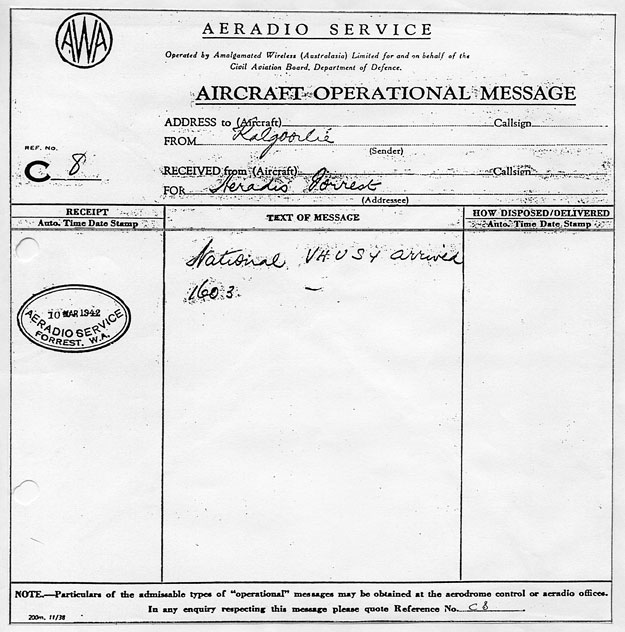
Below: A typical Aeradio message dated 10 March 1942. It was transmitted from Kalgoorlie Aeradio to Forrest Aeradio and reports the arrival of Australian National Airways' Douglas DC-2 VH-USY Bungana at Kalgoorlie at 4.03 pm. Note that the message is on an AWA message form although the Aeradio stations had been taken over by DCA by this time. In 1936 Bungana was the first of the modern 'all metal' American airliners imported into Australia.
Ivan Hodder continues the story in his own words:
"On arrival at Alice Springs a gang of Public Works Department (PWD) labourers awaited my directions. They erected the 80-foot steel masts and anchored them to concrete blocks, which had been installed in anticipation. The radio equipment was installed in the Guinea Airways passenger rest room. The work took three and a half weeks, and at about 4.30pm on a Saturday afternoon, the first tentative call was made on 6540 KHz by Morse key to Adelaide. To my surprise and relief, they came straight back on voice with a ‘reading you five’ report. Charlie Magee, a PMG Radio Inspector from Adelaide, acted as the Station’s first Aeradio Operator until DCA appointed Jim Jack permanently to the position.
With Alice Springs a going concern, I packed up my tool kit - nothing missing - and headed up north by Guinea Airways’ Lockheed. Passing through Daly Waters I was told that the Aeradio station was being constructed by a Post Office Engineer from Adelaide, but I had no chance to meet him as the equipment was being installed in the local Post Office some distance from the aerodrome. The Postmaster, Jim McMahon, doubled as the Aeradio Operator.
Arriving at Darwin I found that all available accommodation in town was taken by RAAF construction crews working at the ‘four mile’ aerodrome. The civil aerodrome manager, Alan Collins, suggested that I sleep in the radio room-to-be, and he provided a bed - with mosquito net - and arranged for me to have all my meals at the Parap Hotel.
Next day I checked out all the materials which AWA had shipped up from Sydney and found it all there with the exception of one 20-foot section of mast. I went to the PWD and asked that a search he made for it at the wharf and freight sheds, and for a working gang to be sent out to the ‘drome’ in a couple of days’ time. A motley gang of eight labourers were delivered by truck at 8.30 each morning and recovered at 4.30 in the afternoon. By good luck, they succeeded in assembling the first mast on the ground which they painted, attached 64 foot-steps, guy wires and obstruction light cables. With fingers crossed the mast was pulled up and anchored to concrete blocks in the ground.
The second mast was then started but the missing section of pipe was causing a delay. The PWD had no success in locating it - even to checking on trucks standing at sidings along the Birdum railway line. Finally I went to the freight shed to have a look around myself. A ‘wharfie’ sidled up and asked if I was "still looking for that bitta pipe," and when I nodded he said "I know where it is - it’s in twenty-five feet of mud and water alongside the wharf." It had slipped out of the sling during unloading.
The only replacement piece available was 18 inches out of true. That bend just had to come out. With four men holding each end we just positioned it, bend uppermost, over a slight depression in the ground and I drove the local ‘ute’ over it, back and forth, for about 15 minutes. After that treatment it was perfectly straight.
With this problem solved the second mast was up in much less time than the first, the communication antenna was strung between them and the direction finding (DF) loops hung from the second one. Finally the various leads were attached to the feed-through insulators on the radio room’s outside wall.
The AS9 aircraft transmitter and receivers were installed, as were the 6 volt and 24 volt battery banks and the Delco charging unit. Finally the DF receiver was calibrated with the help of Max Vincent - the launch operator from the flying boat base.
Good radio communications with Alice Springs, Daly Waters, Groote Eylandt and Koepang were possible with this low- powered installation. The six-weeks stint at Darwin had been hard work and a lot of frustration, but this was offset by a successful conclusion to the exercise.
I returned to Essendon where I resumed duties with the technical maintenance unit which had been set up to handle our own problems instead of farming them out. There were four of us - Ted Betts, Mason Chapman, Rod Torrington and myself. We handled mainly problems associated with the new Lorenz Radio Range.
I was back again in the northern areas in October 1940, where I was on loan to the RAAF to ‘indoctrinate’ all DCA operators in the mysteries of Defence Services communications procedures. I visited all Aeradio stations from Brisbane north to Cooktown, then west to Karumba and Groote, down to Charleville and Cloncurry, on to Daly Waters and finally south to Alice Springs. I spent about a week in each place, depending on the number of operators there and including the time involved in lectures and exercises.
I never did complete the second half of the project as more important things had come up. I was back in Darwin in January 1941 on my way to Portuguese Timor to install a typical AS9 transmitter and battery operated receiver at Dilli. The station was required there when arrangements were made for Qantas to operate a weekly service by deviating the Darwin/Koepang sector via Dilli; westbound one week, and eastbound the next. The only other radio facility in Dilli had been ship-to-shore, and Qantas operations refused to go in there unless Aeradio communications and a homing beacon were provided. Canberra agreed to this, and DCA provided the equipment free of cost to Qantas.
I left Sydney by Flying Boat on 17 January 1941 after collecting the necessary equipment from Qantas and I over-nighted at Townsville where antenna items came aboard. Arriving at Darwin next afternoon via Karumba and Groote, I completed the equipment pickup before departing next morning for Dilli where I was met by the Governor. After three weeks really good radio contact was established with Darwin and with flying boats on departure from Darwin or Koepang."
Ivan
continued to work in the Darwin area, installing the Lorenz 33 MHz Radio Range for the purpose of assisting Guinea Airways aircraft into Darwin at night time.
He returned south just nine days before the Japanese bombed the town. The Aeradio
facility was later relocated at Daly Waters. He finally retired as Examiner of
Airmen (Radio) in 1964, and after an active retirement at Myrtleford (Vic), Ivan
passed away in 1995. His collection of writings, tape recordings and photos are
in the archive of the Civil Aviation Historical Society.
(Message form: CAHS collection)
Back to the main Air Traffic Services index page
If
this page appears without a menu bar at top and left, click
here